Saturday, June 5, 2010

Swarms and Nucs


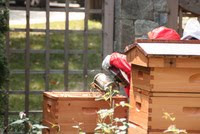
We didn't exactly follow standard beekeeping procedure on this, but my colonies recently swarmed (without our knowledge) and left us in a confusing situation. A swarm is a natural occurrence for a hive as their population grows so large that they no longer have strong pheromones from the queen, or they do not have enough space, resulting in the creation of new queen cells while a large portion of the colony flies off with the old queen to a destination that scout bees have located. We hope that ours went to a nearby park. I missed the queen cells that were the warning signs of a swarm (although my mom captured a picture on the bottom left that may have been their departure gathering), and when I next went in the colony, there were 7 queen cells. 3 of them were in a deep that I had borrowed from my mentor Toni Burham. So, because the boxes are on loan until she can find a better home for them, we decided to start a nuc, which is a colony usually contained in one deep that can be sold as a starter for a new colony- basically a bee colony on a small scale. We took off the box and sat it a few yards away from the colonies, using more borrowed material (including a screened inner cover giving them better ventilation). The nuc has become my sister's "training project," preparing her to become my dad's cobeekeeper when I am away in China for the year. She hopes to grow another colony. Starting nucs from local bees (my hives came from nucs from a local beekeeper, and the fathers for this new nuc will be local as well) is important for supporting the local bee community as well as creating a strain of bees better adapted to our area rather than importing them. While bringing in new genetic material can often be helpful for many issues such as hygenic behavior, local bees are ready for the issues such as tempertature that face them here.
Posted by Picasa

Saturday, May 15, 2010

A Sound of Spring


Buzzing is really a sound of spring. The season has begun in earnest with some warmer weather and interesting finds. The two pictures on the top show the (multicolored!) hives of a master beekeeper we visited on the Eastern Shore. What looks like a solar panel on each of the hives is a solar panel to power a ventilator that is completely self sufficient. This beekeeper was doing experiments in many of his 30-odd hives both with ventilation such as empty chambers on top with holes cut in the sides and a fan to circulate the air, and used a solar ventilator in each hive for a system he found worked very well to avoid stagnant air but not waste the bees energy on fanning in the hot months of the approaching summer. He was utilizing two-queen colonies (Top Right) which leads to a much more productive colony with twice the number of bees because both queens are actively laying. There are two deeps side by side to serve as brood chambers with queen excluders over the shared honey supers and boards half the size of an inner cover to close up the tops of the brood chambers.
On another note, the two pictures on the bottom show how my hives are collecting nectar-fast! I can hardly lift off the top box.
Posted by Picasa

Tuesday, May 4, 2010

The White House Bees

On April 22, take your child to work day, my sister Audrey and I were given a extraordinary opportunity to go to the White House. We visited with the White House bees as well as teaching the hundred or so children who came about bees with Charlie Brandts, the White House beekeeper who we loved meeting, and my mentor Toni Burnham. This was an extremely exciting experience and we got to see first hand the enjoyment the children took at trying the honey and the interest many showed to pursue this knowledge further. We also got an added bonus-- Charlie was kind enough to give us a fantastic tour of the White House.


Posted by Picasa

Wednesday, February 10, 2010

Environmental Urban Living Classes

This is a wonderful opportunity DC is putting forward to learn about beekeeping, or start your own hives. We'll have a number of area speakers, and Toni is a fantastic teacher!

URBAN BEEKEEPING
February 22nd, March 1st , 8th and 15th 6:30pm-9:00pm
Sherwood Recreation Center 640 10th St. NE

Toni Burnham, DC’s own beekeeper extraordinaire will be teaching the basics of urban beekeeping in this
four session series. Upon completion of the class students are encouraged to volunteer at one of DPR’s bee
hives. (Pre– registration required at Kelly.melsted@dc.gov)

Tuesday, February 2, 2010

A Few Days of Spring!


The warm weather last week was an exciting time for the bees to get out of the home they
hadn't left since early December. I took the opportunity to feed the bees fondant- which uses the
same recipe as the special icing for cakes- so that they could replenish their stores. There is still at
least another month until nectar flow, and the girls are going through their winter food fast. I also
took some pictures of them enjoying their freedom! The upper two pictures are the bees feeding on
fresh fondant. As you can see, they were overjoyed!!

Posted by Picasa

Tuesday, December 22, 2009

Hives in the "Blizzard of '09"


Winter is certainly a beautiful season, especially in the large snowstorm we had over the weekend when the hives' roofs got a hat. Winter can also be a tough time for the bees, however. This season is the real trial when the beekeeper sees whether the bees have stored enough to eat, have been treated sufficiently for disease and pests, and are genetically predisposed for getting through the winter. Colony Collapse disorder has also become an issue during the winter, although its severity is declining since its spike in 2007. Many times the hive will not make it-- last year there was a 25% loss reported.
Posted by Picasa

First Batch of Honey


The story of 'Backyard Honey'

"Alison's honey is produced in Washington, DC. It is unfiltered and still contains the clean, edible, and very nutritious products of the hive-- wax and propolis."

Posted by Picasa